
Silicone render specialists, for the whole house
A tired brick or pebbledash elevation goes to a clean, through-coloured K Rend or Licata finish that sheds rain, still lets the wall breathe, and never needs painting again. With insulation underneath if the walls are cold.
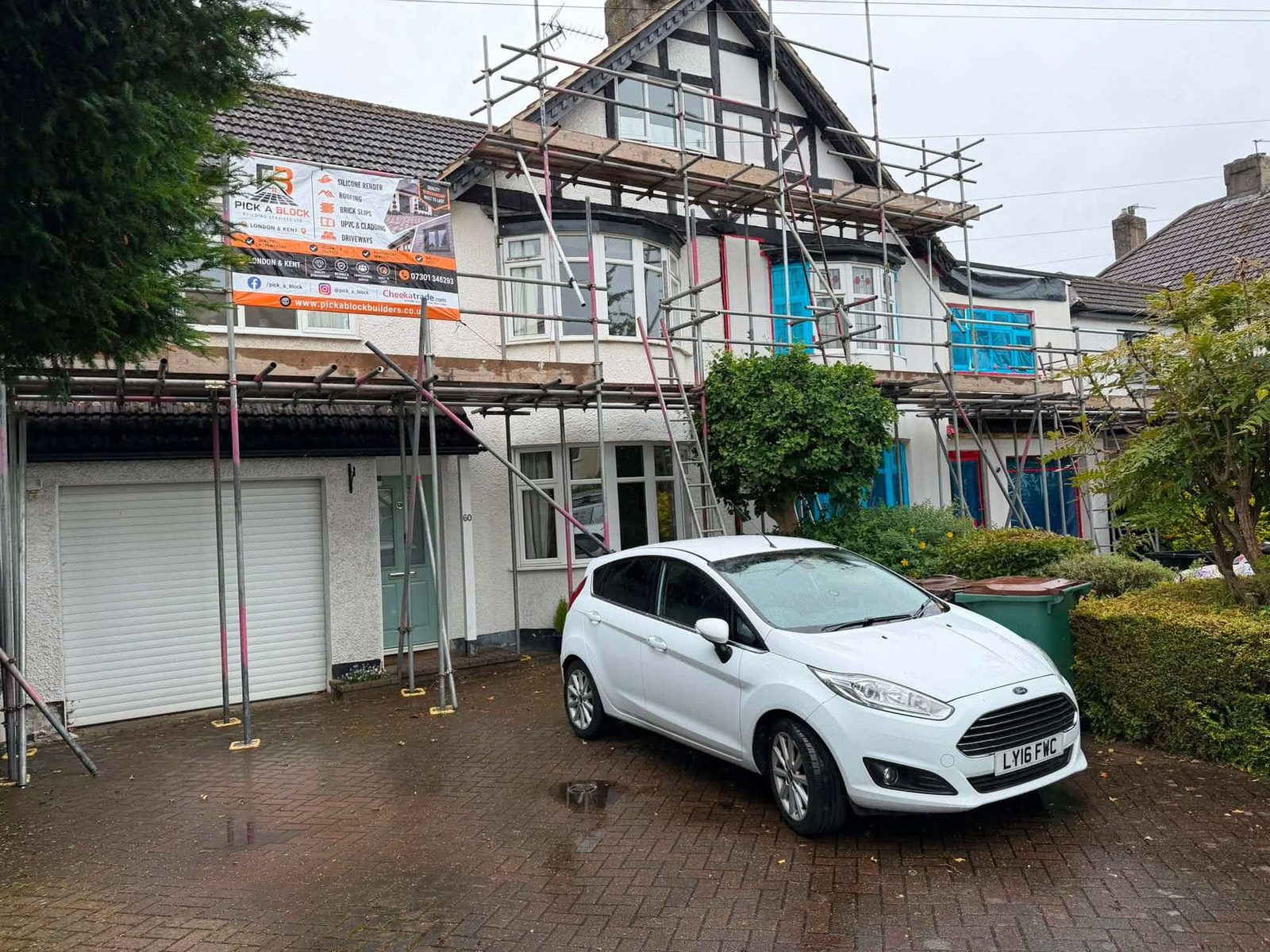
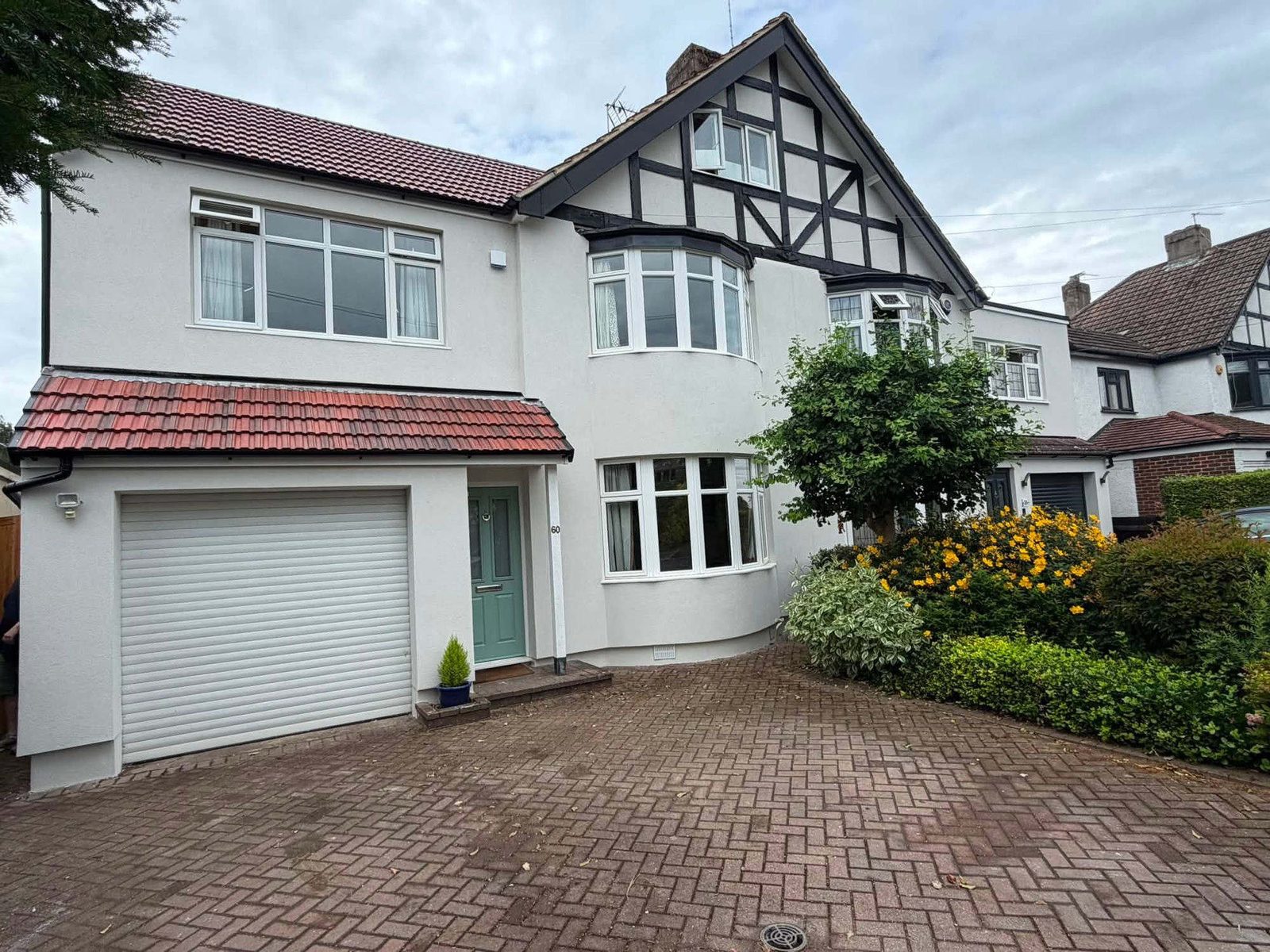
One of Kyren's own jobs, photographed from the same spot on the pavement. More of the work, and the full before-and-after, further down.
- 20-year guarantee
- Fully insured
- No money upfront
- Free written quote
Get a written price for your elevations
The quality of the workmanship really stands out.
Tell him about the job
Three details is all it takes — name, phone and area. The photo is optional.
- 20-year guaranteeIssued to you in writing when the scaffold comes down.
- Fully insuredOn every job, before anybody goes up a scaffold.
- No money upfrontNothing is paid before the work starts.
- Free written quoteThe survey is free, the quote is written, and there is no obligation at the end of it.
Would you rather talk it through? 07301 346293Kyren answers his own phone, and calls back within the half hour if he is up a scaffold.
What it costs
Every house is different, so the number comes after Kyren has measured yours. What is fixed is how the quote is written.
- The quote
- Written, free, and the number on it is the number you pay. Kyren measures the elevations himself before he gives you one, because the size of the walls, the access and what has to come off first are what decide it.
- Scaffold
- Priced separately, as its own line on the quote. It is not folded into a rate and we are not going to pretend it is.
- Paying for it
- No money upfront.
It would be easy to fold the scaffold into the square metre rate. It makes the headline number look better and it moves the surprise to the end of the job. We quote it as its own line instead, so the figure you are given is the figure you pay.
If you are holding another quote and it does not say anywhere what the scaffold costs, that is worth a question before you sign it.
Every quote is written down and free, and there is no money upfront on any of it. Kyren answers his own phone. If he is up a scaffold when you ring he calls back, usually within the half hour.
Do we cover you?
Our team of specialists travel significant distances to get your job sorted. The quickest way to find out about your address is to ask. Kyren answers his own phone, and if he is up a scaffold when your enquiry comes in he rings back, usually within the half hour. The visit is free and the quote is written.
Still deciding? The detail is all below.
Rated on Google
What silicone render actually is
Worth understanding before you spend anything, because most of what makes it worth having is invisible once it is on.
Silicone render is a thin-coat, through-coloured topcoat. The pigment runs all the way through the material rather than sitting on top of it like paint. A chip does not show a different colour underneath, and there is nothing to repaint every few years — which is the part most people have not thought about, because a painted elevation around here wants doing again every five or six.
The useful part is what it does with water. The face is hydrophobic, so rain beads on it and runs off instead of soaking in, and it takes the dust and the traffic film down the wall with it as it goes. That is why a silicone elevation still looks clean years after a painted one on the same road, facing the same weather, has gone grey and green on the north side.
At the same time it stays vapour permeable, so moisture already inside the wall can still get out. Sheds water on the outside, breathes on the inside. That combination is why it suits the solid brick and older cavity walls so many houses have, where sealing a wall up behind something impermeable causes more problems than it solves.
And it is a system rather than a coating. A basecoat with glass fibre mesh bedded right through it, beads to every corner, reveal and sill, a bell drip where the render stops, and then a K Rend or Licata silicone topcoat floated to the texture you have chosen, in the colour you have chosen. The topcoat is the part you see and the smallest part of the job.
What it is replacing
Whatever is on the front of your house now, it is costing you something. Usually a scaffold every few years.
- Painted pebbledash
- Pebbledash was quick to put on and it is expensive to live with. The stones hold dirt, the paint over them goes chalky, and every time you want it freshened up you are paying for a scaffold to do it. Render gives you a flat elevation and takes the repainting off the list entirely.
- Old sand-and-cement render
- A rigid coat with nothing in it to hold it together. It cracks as the building moves, water gets in behind the crack, and the frost does the rest until the coat is hollow and drumming when you tap it. A modern system has mesh through the basecoat precisely so that the movement has somewhere to go.
- Painted brickwork
- Paint on brick is a commitment, not a finish. It has to be redone, it traps moisture in the brick behind it, and it never quite goes back to brick afterwards. If somebody has already painted it, render is usually the honest way out.
- Another coat of masonry paint
- The cheapest option on the day and the dearest across ten years, because you buy the scaffold again every time. Worth doing the sums before you decide: two or three repaints and the scaffold that goes with them is not far off the cost of doing it once, properly.
The argument for render is not really about how it looks on the day it goes on. Anything looks good the day it goes on. It is about what the elevation costs you to keep looking like that, and a through-coloured finish that sheds water costs you nothing at all for a very long time.
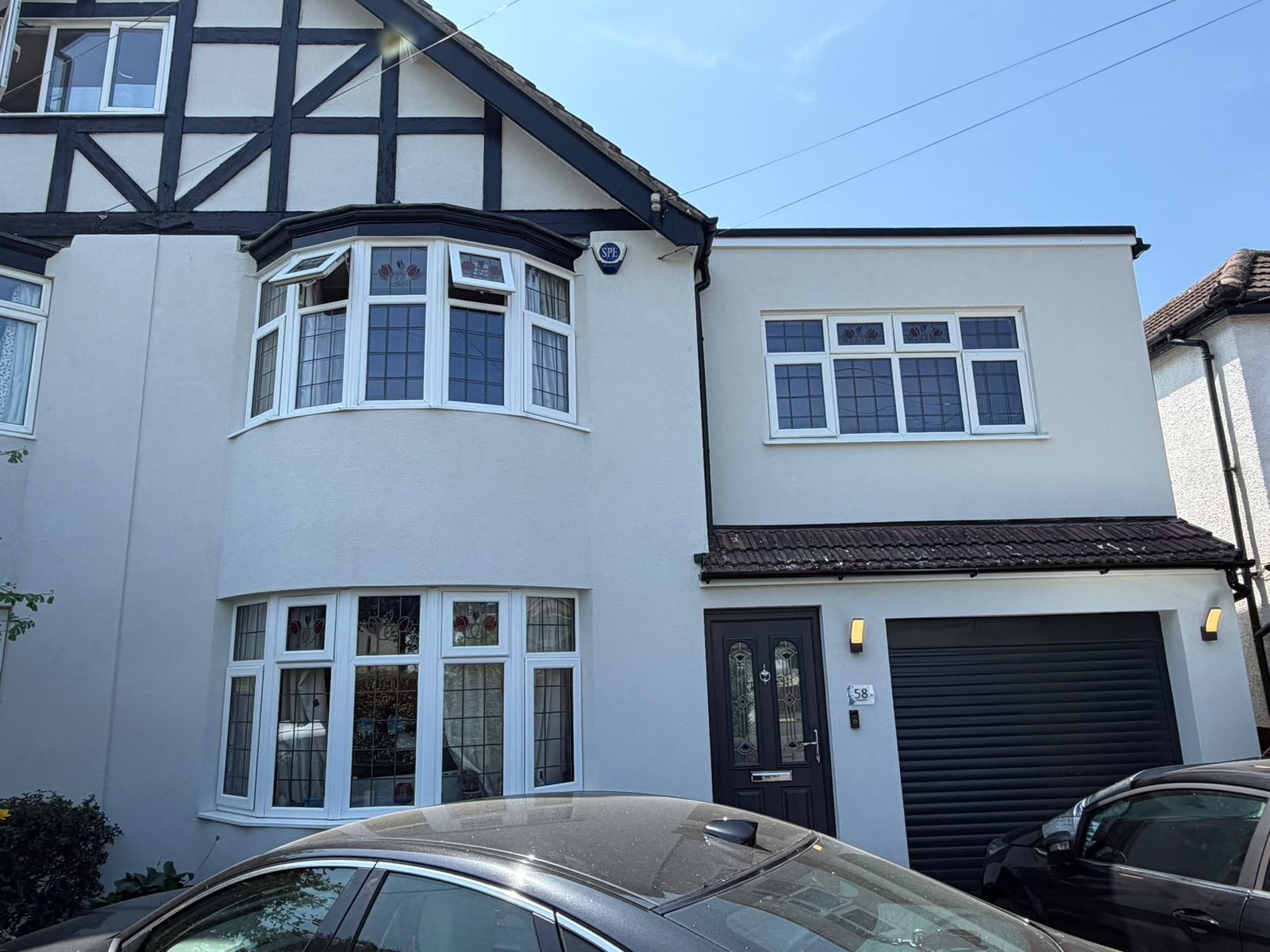
The look is not nothing, though. The front of the house is the first thing anybody sees, including anybody you ever try to sell it to. That is not a promise about what your house is worth — nobody honest can tell you that from a website. It is just what a flat, clean, modern elevation does to a first impression, and you can see it for yourself in the photographs further down this page.
And if the wall is cold as well as tired, the boards go on under the render in the same operation, off the same scaffold. That is external wall insulation, and it is the version most of our whole-house customers end up choosing.
The same house, from the same spot on the pavement
Five things decide whether a render job lasts
None of them is the topcoat, which is the only part anybody looks at on the quote.
Render that fails almost never fails because of the material. It fails at the joints, the edges and the background — the parts that are covered up on the same day they are done and that nobody can inspect afterwards without taking the wall apart.
Which is an awkward thing to be told, because it means the quote you are comparing does not really tell you what you are buying. So here is what we do, in enough detail that you can ask anybody else the same questions.
If somebody quoting you cannot answer these off the top of their head, that is worth knowing before you sign anything.
- What is underneath it
- The background decides everything. Whatever is already on the wall is either sound enough to render onto or it is not, and the honest answer is sometimes that it has to come off first. Kyren tells you which one you are looking at when he comes out, not once the scaffold is up.
- Mesh, right across
- Glass fibre mesh bedded into the basecoat across the whole elevation and overlapped at every joint. This is the layer that stops the wall cracking. A strip over the obvious corners is not the same thing and it is where most cracked render started.
- Beads to every edge
- Corner beads, stop beads and reveal beads to every edge, reveal and sill. Straight lines on a finished wall are not down to a steady hand, they are down to somebody having spent a day setting beads before any render went on.
- Somewhere for the water to leave
- A bell drip where the render stops, so rain runs off the face of the wall and drops clear instead of tracking back underneath it. Miss this and you get a dirty stripe under the render inside two winters, and worse than a stripe eventually.
- Everything off the wall first
- Pipes, aerials, lights, meter boxes, alarm bells. They come off and go back on afterwards rather than being rendered around, because rendering around something is where the water gets in and it is visible from the pavement forever.
How a render job actually runs
Seven stages, photographed on Kyren's own jobs while the work was still open, which is more than most render websites will show you.
- 01
Survey and written quote
Kyren comes out, measures the elevations and looks at what is already on the wall. You get a written quote with the scaffold priced as its own line. No charge, no obligation and no money upfront.
- 02
Scaffold and prep
Scaffold to every elevation being worked on. Windows and doors masked, and anything coming off the wall comes off first.
- 03
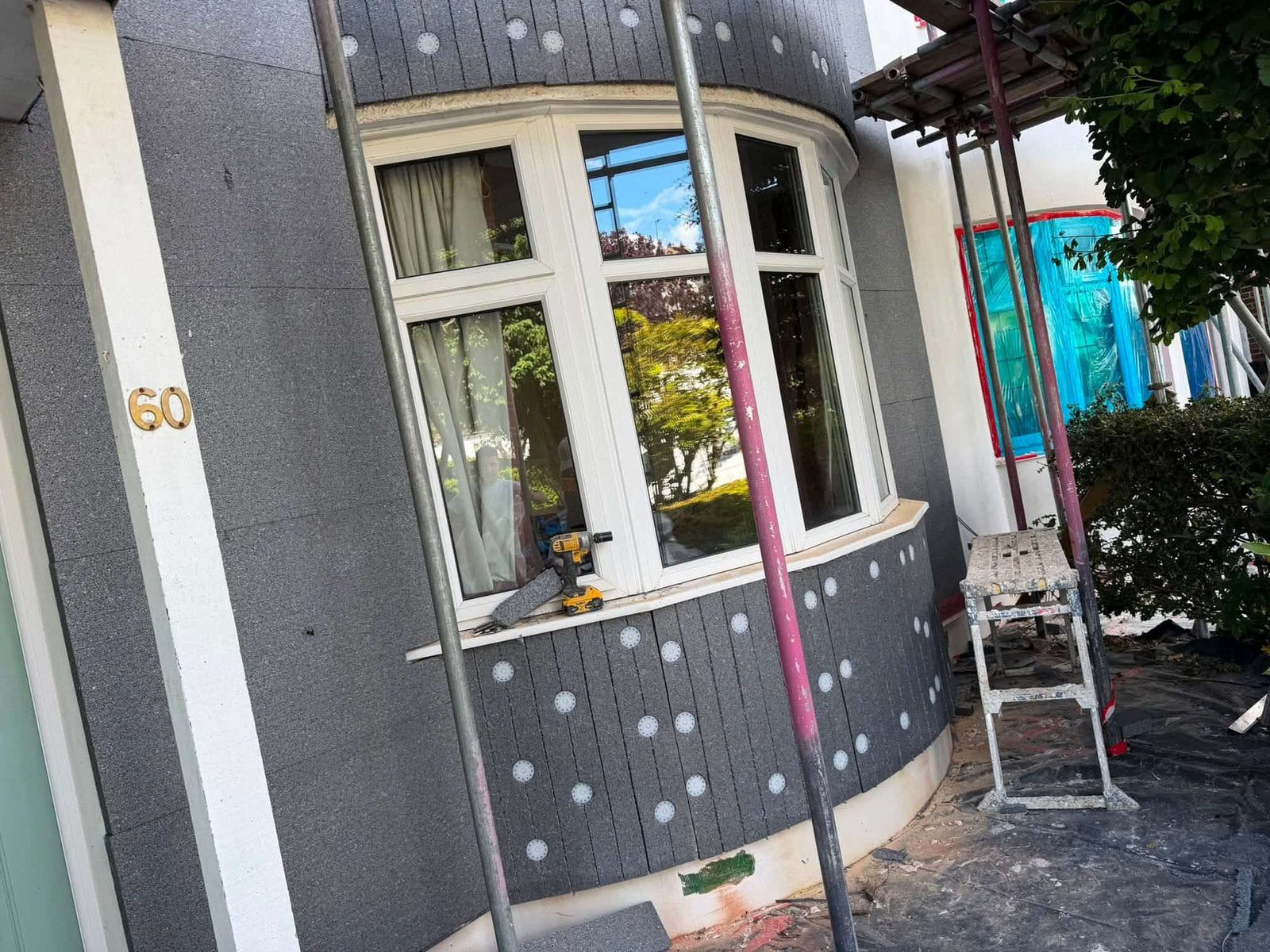
Insulation boards, where they are going on
Boards fixed back to the original wall with adhesive and mechanically pinned. The fixings are what carry the load, not the adhesive.
- 04
Basecoat and glass fibre mesh
Mesh bedded into a basecoat across the whole elevation, overlapped at every joint. This is the layer that stops the wall cracking.
- 05
Beads to every edge
Corner beads, stop beads and bell drips to every edge, reveal and sill. Straight lines here are the whole reason a finished wall looks straight.
- 06
Silicone topcoat
K Rend or Licata silicone, applied and then floated to the texture you have chosen. Colour through the coat, so it is not a paint film waiting to peel.
- 07
Scaffold down, guarantee issued
Everything that came off the wall goes back on, the site is cleared, and the 20-year guarantee is issued to you in writing.
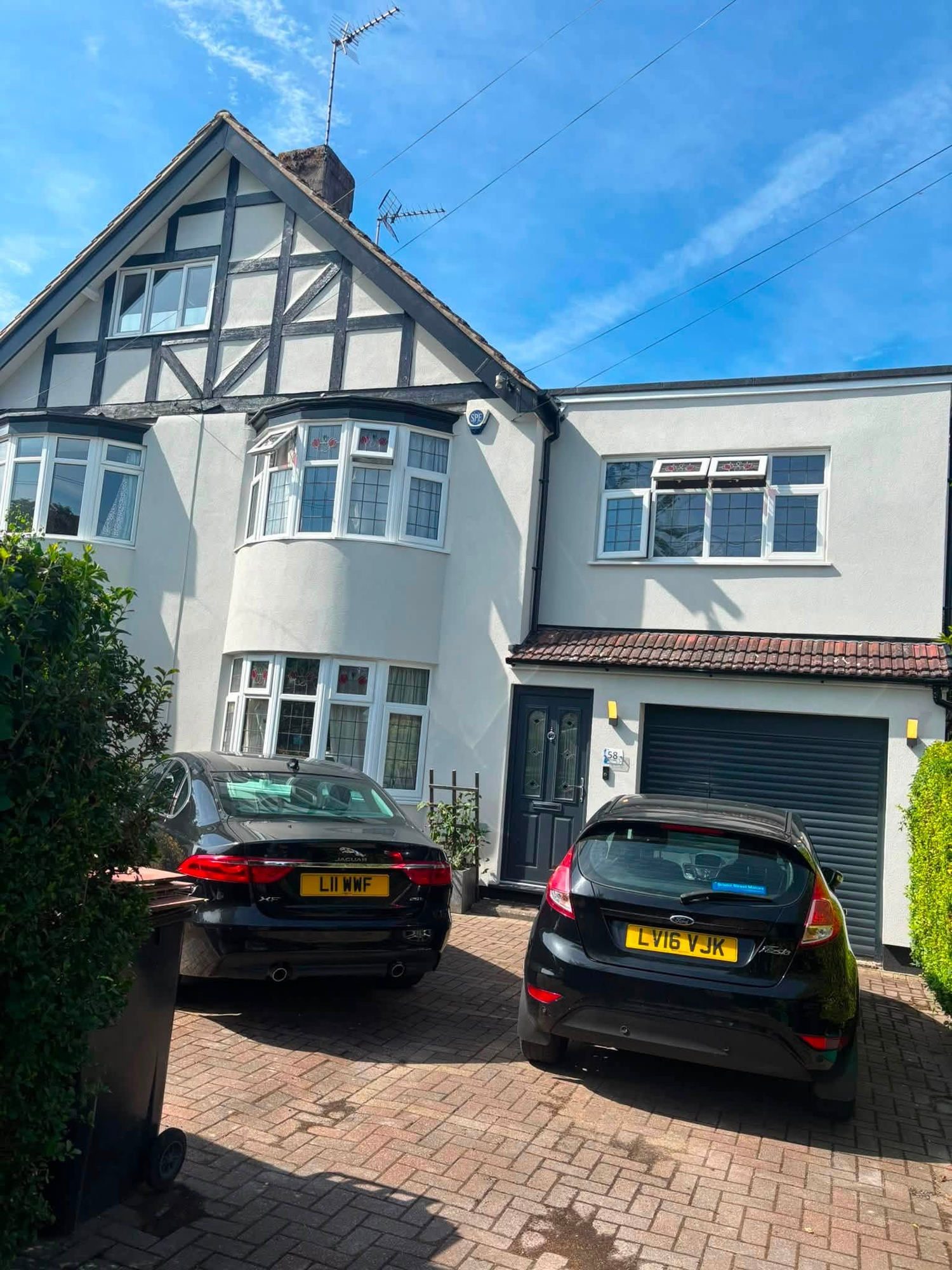
Finished elevations
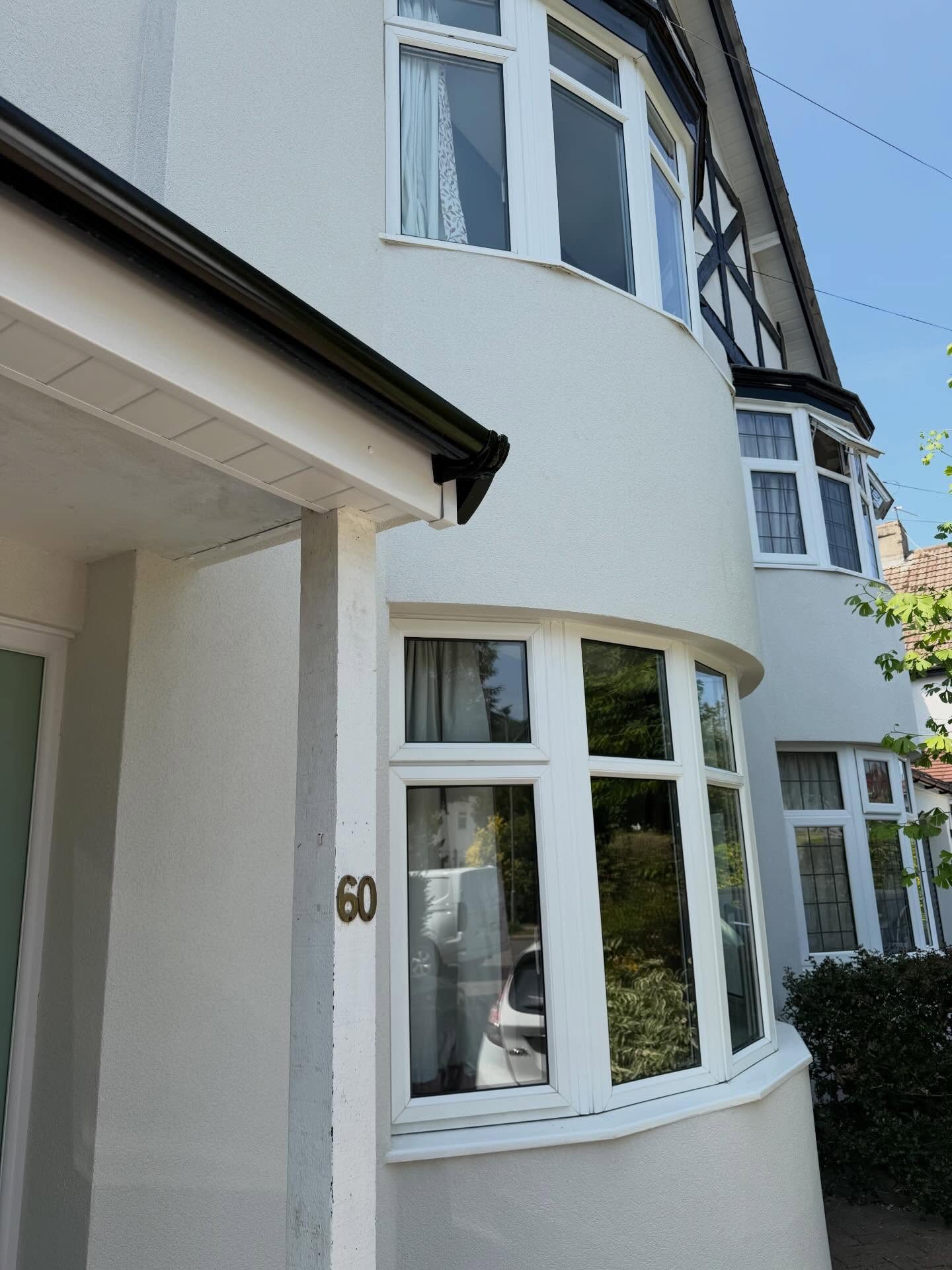
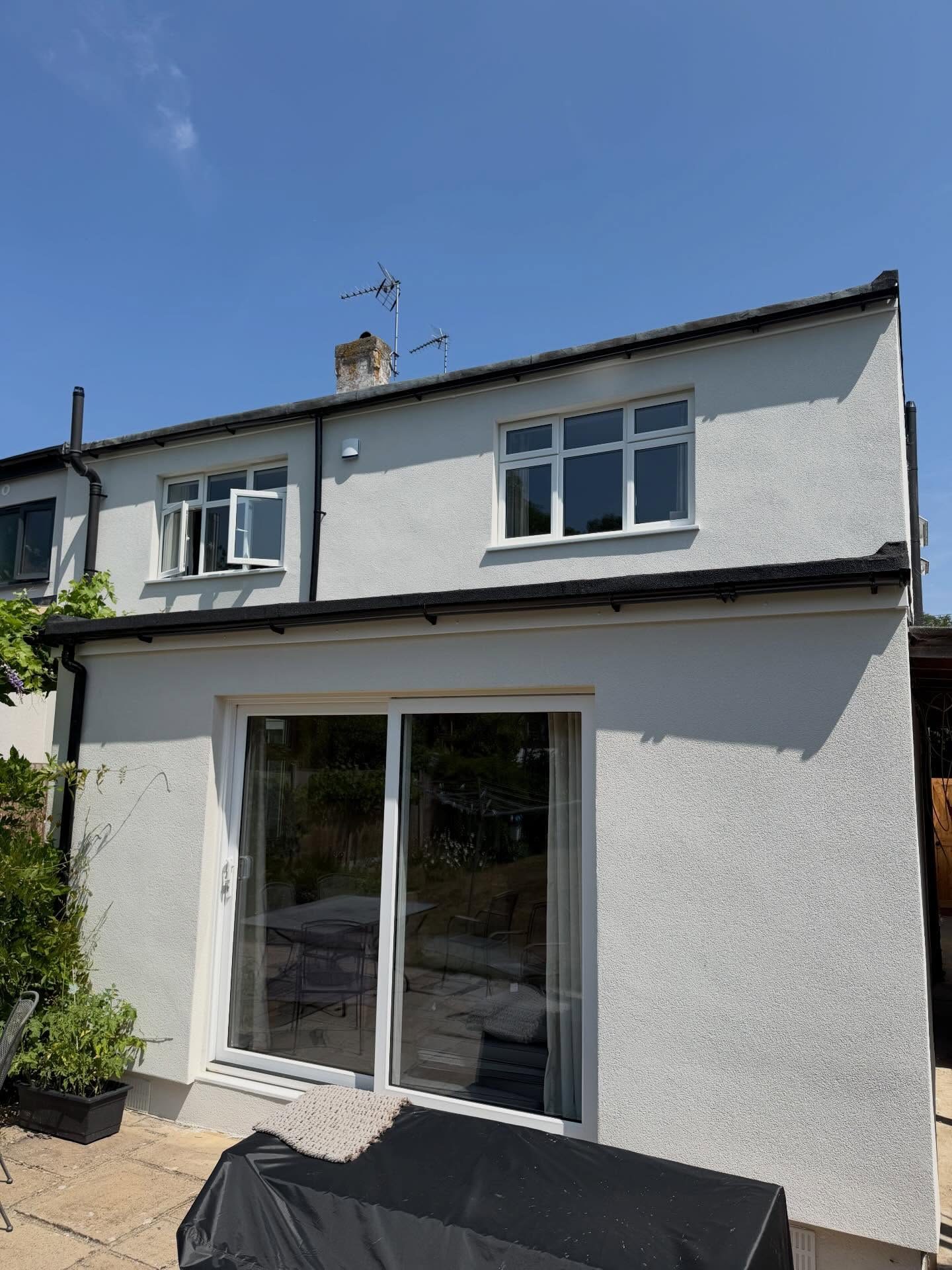
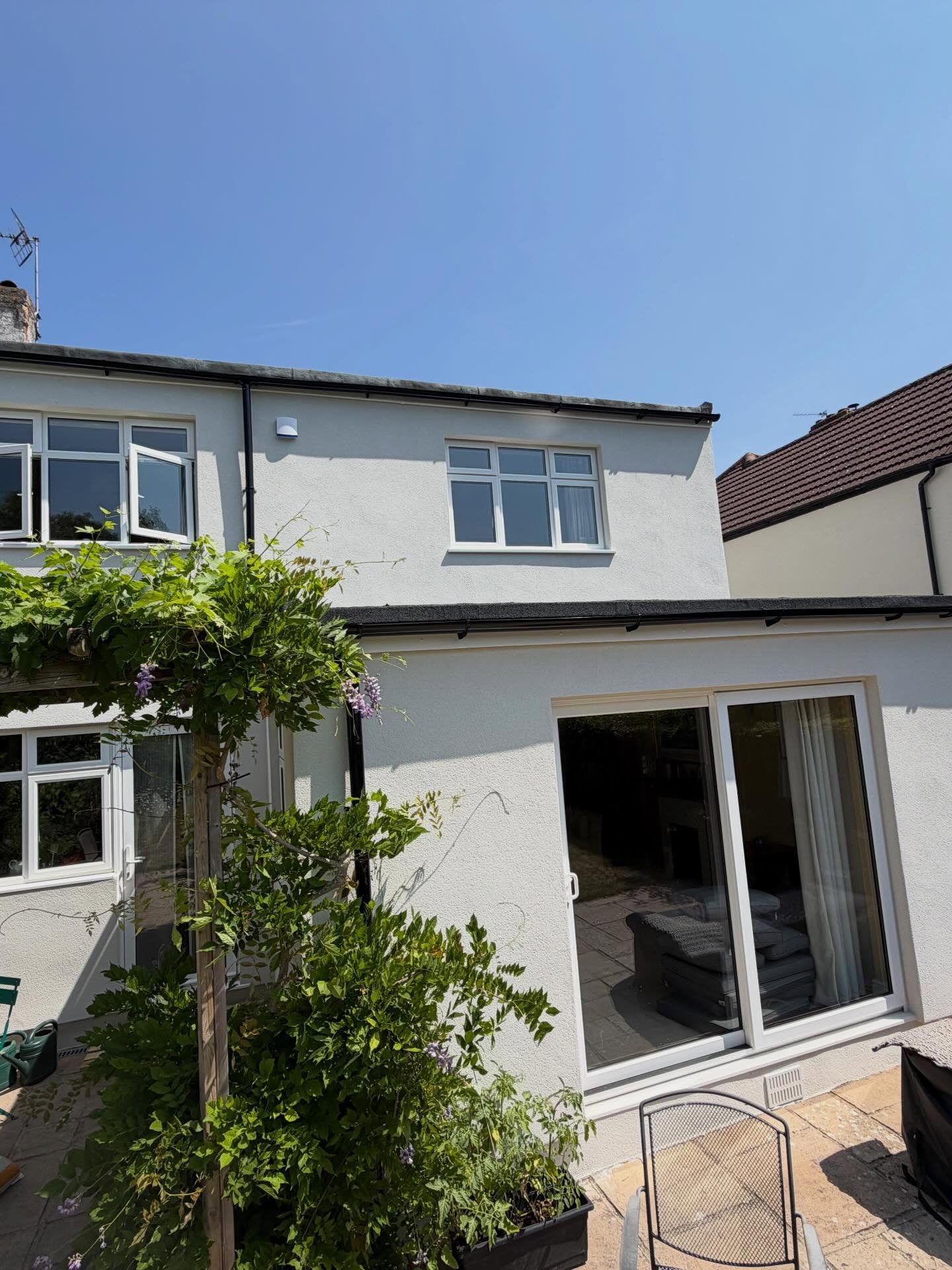
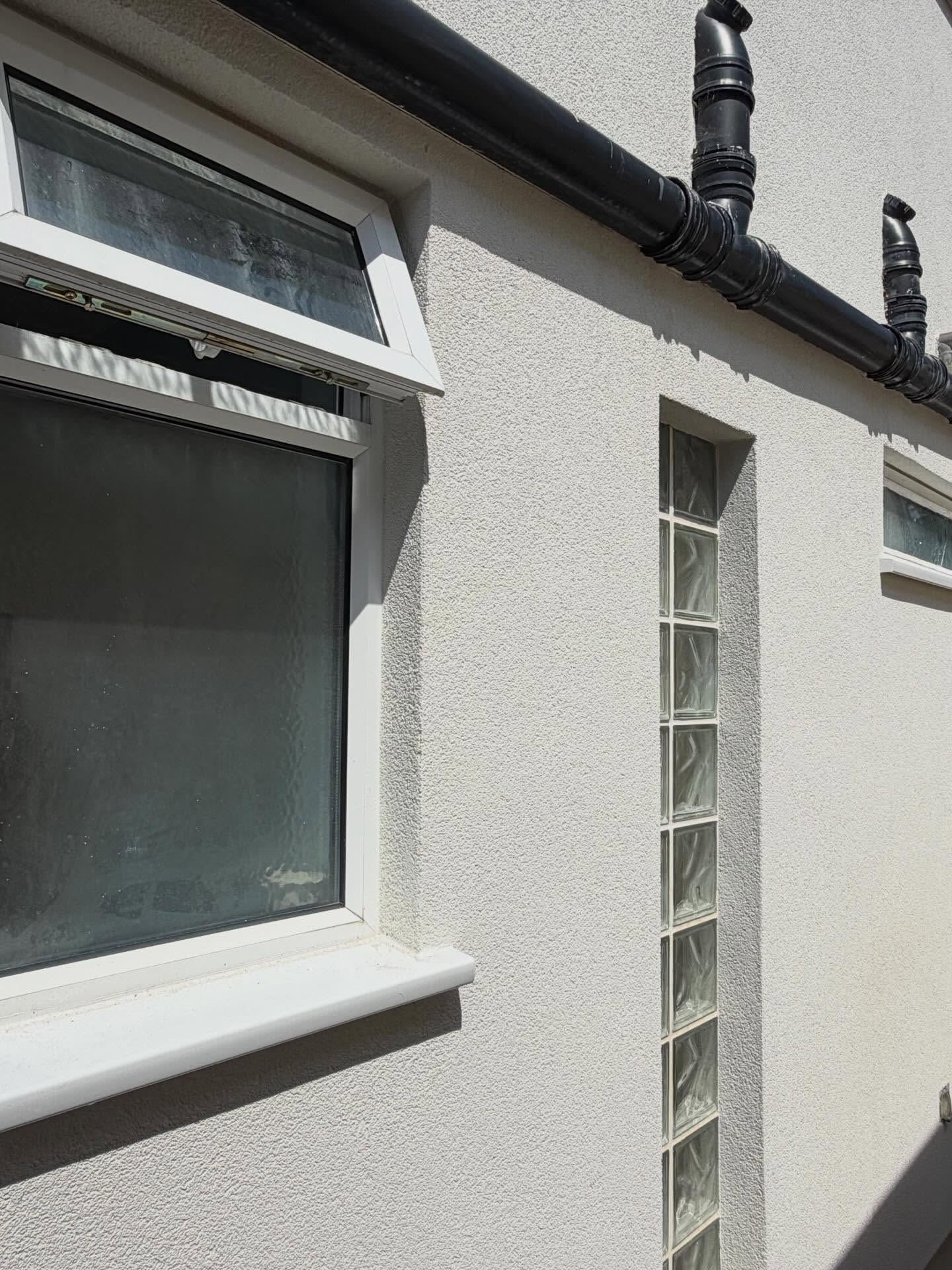
Is this the right answer for your house?
If your walls are solid brick and cold, external wall insulation under the render is usually the better answer than render on its own. You are paying for the scaffold either way, so the boards are the cheap part of the job to add.
If the existing render is sound and you only dislike the colour, say so. Sometimes the honest answer is that you do not need us to take it all off.
If the property is in a conservation area, check before you commit. Permitted development rights for cladding and render are removed in some areas, and that is a planning question rather than a building one. We would rather tell you that now than halfway up a scaffold.
If render is not right for the elevation, brick slips or cladding may be. And if the roof is tired too, do both off one scaffold — it is the single biggest saving available on a job this size. Not sure we come out to you? Ask — the team travel significant distances to get a job sorted.
One review, published in full
We recently had our roof replaced and our home fully insulated and rendered, and happy with the finished result.
From the initial quotation through to completion, the team were friendly, professional and worked incredibly hard. They were always happy to answer our questions and kept us informed throughout the project.
The quality of the workmanship really stands out. The new roof, leadwork, gutters, fascias and insulated silicone render have completely transformed the appearance of our home. The attention to detail is excellent, and the house now looks modern, fresh and finished to a very high standard.
The main bulk of the work only took two weeks! Like any major building project, there were a few snagging items and the final clean-up took a little longer than we'd expected.
We would recommend them to anyone looking for roofing or rendering work. Thank you to the whole team for your hard work.
Common questions
Can silicone render go straight onto my existing wall?
Sometimes. It depends what is already there and what condition it is in. Kyren will tell you which one you are looking at when he comes out to measure up.
Will it crack?
The glass fibre mesh and basecoat under the topcoat are there to stop that, and so are beads on every corner and reveal. It is the preparation that decides it, not the topcoat.
What does it cost?
It depends on the size of the elevations, what is on the wall now and the access, so Kyren measures up before he gives you a number. The visit is free, the quote is written, the scaffold is its own line on it, and there is no money upfront.
Is scaffold part of the price you quote?
No, and the quote says so. Scaffold is its own line on it. Folding it into a square metre rate makes the headline number look better and moves the surprise to the end of the job, which is not how we would want to be quoted either.
Does it need painting?
No. The colour runs all the way through the material rather than sitting on top of it, so there is no paint film to fade off or peel and nothing to redo every few years.
Will it go green or dirty?
Far more slowly than paint, because the face sheds water rather than soaking it up and the rain takes the dirt down with it. Nothing on a British elevation stays new forever, but a silicone wall is still looking clean long after the painted one next door has stopped.
What colours can I have?
Silicone render is coloured through and comes in a wide range. Most people around here go for a white or an off-white, but you are not limited to it, and you pick the texture as well as the colour.
Which systems do you use?
K Rend and Licata. Both are manufacturer systems and you can look either of them up before you decide.
How long does a house take?
It depends on the size of the elevation, the weather and whether the roof is being done at the same time. Kyren will give you a realistic window when he quotes, not an optimistic one.
Do I need planning permission?
Usually not, but permitted development rights are restricted in some conservation areas and a listed building needs consent wherever it stands. Check with your council before committing. We will tell you if we think it applies to your address.
What is the guarantee?
20 years, issued in writing when the scaffold comes down. Pick A Block is fully insured and there is no money upfront.
Still want a price?
Three details is all it takes. Or ring 07301 346293 — he answers his own phone.